

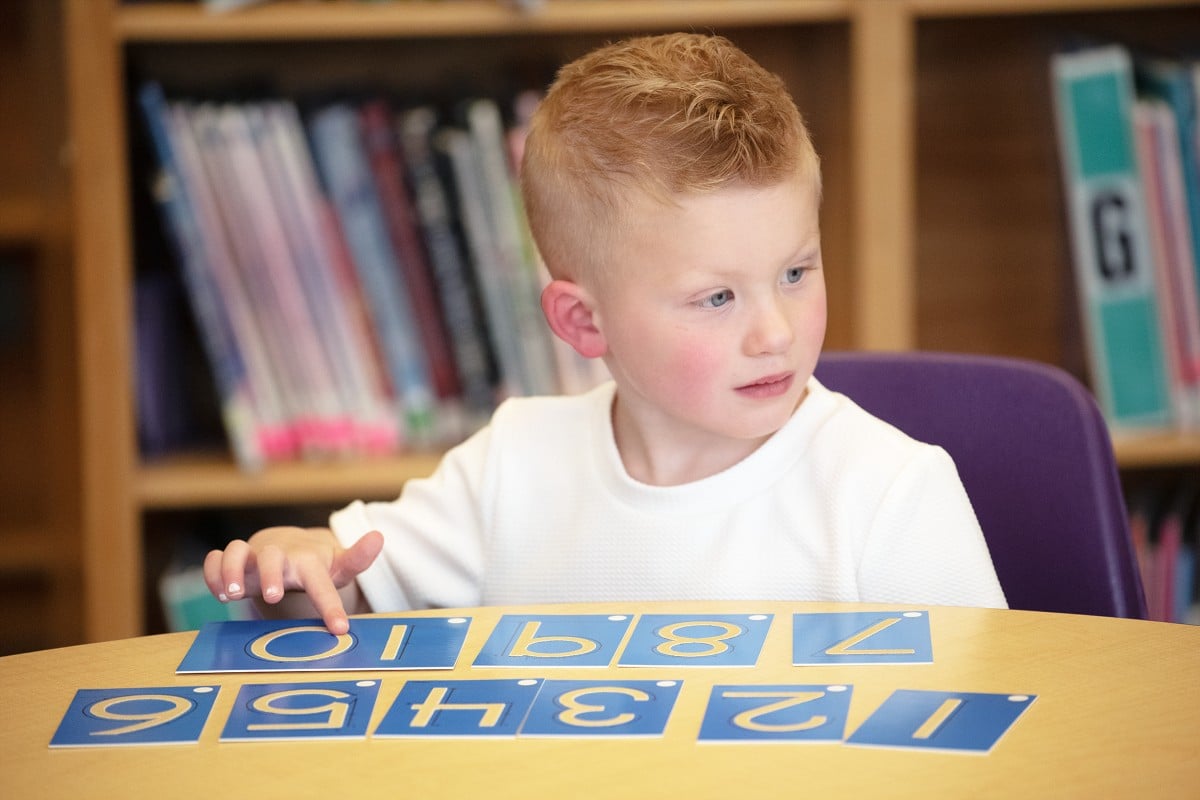
Watch a child build a tower, sort counters, or rearrange tiles, and you’ll see mathematics in motion. Long before formal equations appear, students make sense of numbers, patterns, and relationships through physical interaction.
Research consistently shows that these hands-on experiences are not just engaging, they are essential, helping mathematical ideas click faster and remain firmly embedded over time.
How Hands-On Learning Builds Mathematical Thinking
Cognitive science tells us that physical experience anchors later abstract reasoning. When students sort, build, or compare, they activate neural pathways that support mathematical thought.
This mirrors the well-known Concrete Representational Abstract learning progression:
- Concrete: Students use counters, cubes, tiles, and other tangible tools to model and internalize relationships.
- Representational: Visual models like drawings, diagrams, and number lines help students transition from hands-on exploration to pictorial reasoning.
- Abstract: Students communicate ideas using symbols and numbers, applying concepts across contexts.
These stages are not tied to age; rather, they reflect how learners of all levels build understanding. Students may move back and forth between stages as they tackle new concepts.
Early Learning: Math Begins with the Senses
Long before entering the classroom, children explore shapes, colors, textures, and patterns. Matching socks or stacking blocks may look simple, but these sensory experiences strengthen one-to-one correspondence, early spatial reasoning, and foundational number sense.
In PreK and Kindergarten classrooms, manipulatives make these early intuitions visible. Tools such as counting bears, two-color counters, Unifix cubes, and pattern blocks invite children to construct meaning rather than memorize isolated facts. These tactile materials support key early outcomes, including conservation, sequencing, and emerging operations.
Frameworks from the National Council of Teachers of Mathematics emphasize that mathematical ideas should be experienced through multiple representations. Concrete and visual models are not merely supports for young learners; they are essential components of effective early mathematics.
Primary Grades: Making Structure Visible
As students progress into Grades K-2, visual and tactile tools help them see the structure of our number system. Ten frames make quantity transparent, base-ten blocks reveal the logic of place value, and clocks and number lines give shape to time and sequence. Research consistently shows that these tools strengthen conceptual understanding, procedural fluency, and problem-solving.
Even familiar tools such as fingers remain important representational supports. Far from a sign of immaturity, finger counting often reflects active sense-making and strengthens internal number pathways.
During these years, teacher guidance is key. When educators connect physical actions to underlying concepts, students begin to generalize their learning and explain their thinking with confidence.
Upper Elementary and Middle School: Keeping Concepts Grounded
As math becomes more complex, manipulatives continue to anchor new ideas. Fraction tiles clarify part–whole relationships and equivalence. Geoboards make angles, symmetry, and area visible. Integer chips and number lines support understanding of positive and negative values.
These tools help students confront misconceptions, test conjectures, and solidify mental models.
Manipulatives are not just for that first moment of clarity. Research shows they also support long-term retention and flexible transfer. For many learners, concrete and visual supports remain essential as they encounter ratios, rational numbers, and geometric relationships.
Real-world applications like measuring ingredients or handling money deepen these connections, tying math to meaningful situations and reinforcing the problem-solving focus highlighted in the NAEP framework.
High School: Strengthening Abstract Reasoning
Manipulatives are sometimes mistakenly viewed as tools only for young children, yet high school students also benefit from tactile and visual models. Algebra tiles help students grasp factoring and equations. Function boards and graphing mats support analysis of linear and nonlinear relationships. Geometry solids and dynamic modeling tools bring transformations and congruence to life. In statistics, spinners, dice, and simulations help students connect theoretical probability to observable outcomes.
Additionally, organizations such as NCTM and the Council for Exceptional Children emphasize that manipulatives provide equitable access for multilingual learners and students with disabilities. Their multimodal nature gives every student an entry point into grade-level mathematics.
What Makes Manipulatives Effective?
Research highlights several principles that maximize the impact of manipulatives on learning:
- Intentional Connections: Manipulatives are most powerful when teachers link physical actions directly to mathematical concepts.
- Active Learning: Invite discussion, collaboration, and reflection as students model their thinking.
- Structured Progression: Building from concrete to pictorial to abstract promotes deep understanding and aligns with how students naturally learn.
- Intentional Instruction: Confidence and pedagogical understanding shape how effectively tools are integrated. When teachers are equipped with this, manipulatives become essential tools rather than occasional extras.
- Equity and Access: A variety of manipulatives ensures every student can engage meaningfully with mathematical ideas, regardless of background or learning profile.
The Big Picture: Manipulatives Build Thinkers
Math is a language of patterns, structures, and relationships, but those ideas rarely begin in the abstract. They begin with the experiences students can touch, arrange, compare, and question.
Across grade levels, manipulatives act as a bridge between intuition and theory. They nurture reasoning, empower all types of learners, and strengthen students’ ownership of their mathematical journeys.
When used with intention and strong instructional practices, manipulatives don’t just enrich lessons. They make math make sense.
This article is courtesy of Didax, which creates hands-on resources that make math easier to teach and more fun to learn, www.didax.com.