


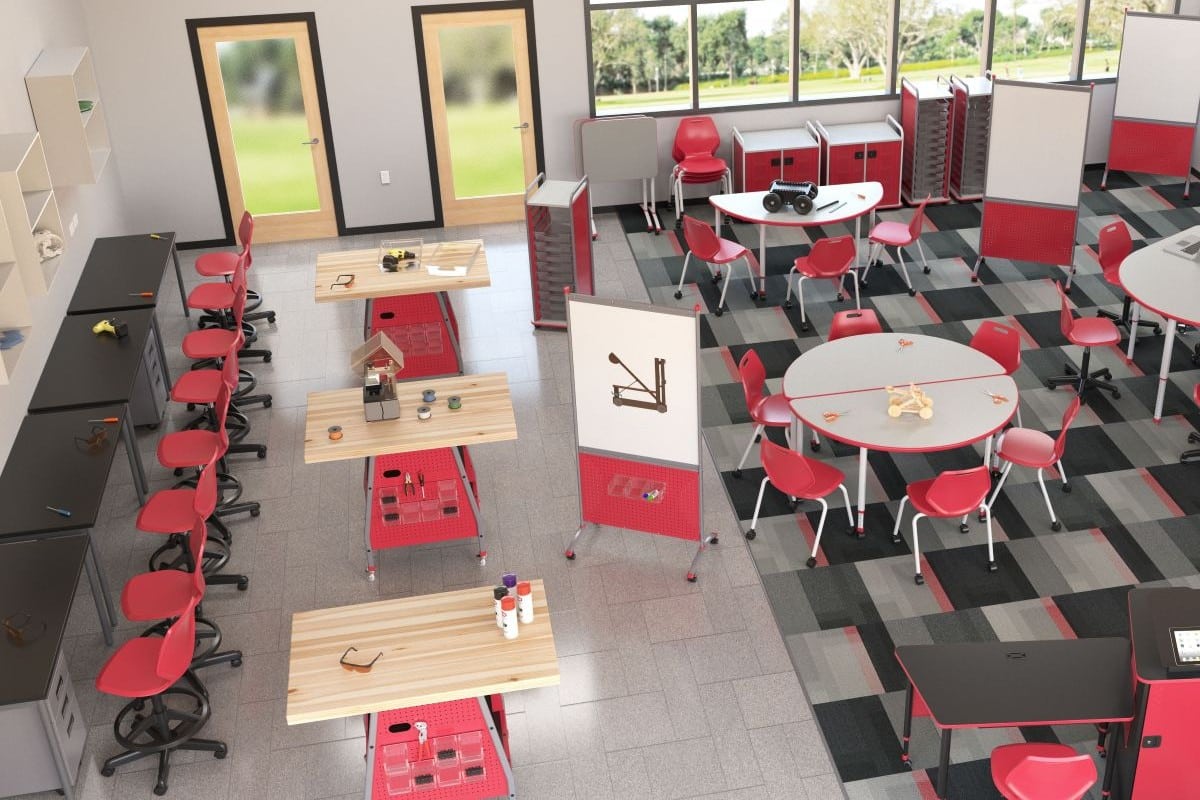
How Balance, Momentum, Growth, and Efficiency Shape High-Impact Maker Environments
Makerspaces are where learning becomes tangible. They are environments designed not just for thinking, but for building, testing, collaborating, and refining ideas through hands-on experience.
In these spaces, students sketch concepts, prototype solutions, work with tools and materials, and learn through iteration rather than instruction alone.
Because of this, makerspaces place unique demands on the built environment. Unlike traditional classrooms, they must support constant motion, varied activities, shared resources, and multiple modes of engagement—often all at once. Furniture is no longer a static backdrop; it actively shapes how learners move, create, and collaborate.
As schools continue to invest in maker-centered learning, one truth is increasingly clear. Effective makerspaces are not defined by the equipment they contain, but by how intuitively the space supports creative work. The most successful environments reduce friction, encourage experimentation, and adapt as projects evolve.
To guide this kind of design, many educators and designers are turning to lessons found in nature. Natural systems demonstrate how balance stabilizes activity, how energy flows through movement, how growth unfolds through adaptation, and how efficiency sustains long-term function. These same principles offer a powerful framework for makerspace design.
From this perspective emerge four foundational pillars: Balance, Momentum, Growth, and Efficiency. Together, they help shape makerspaces that support creativity, collaboration, emotional regulation, and sustained engagement.
At the center of this approach is a core idea that makers learn best when the environment supports both creative freedom and purposeful structure.
BALANCE: Structure Without Constraint
In nature, balance allows complex systems to function without collapsing into disorder. Makerspaces require this same equilibrium. While creativity thrives on freedom, it also depends on clarity, organization, and intuitive structure.
Well-designed makerspaces balance open work areas with clearly defined zones for making, collaborating, storing materials, and reflecting.
Furniture plays a critical role in establishing this structure. When students can easily distinguish between spaces for fabrication, group work, and ideation, they move more confidently and work more efficiently.
Visual order is equally important. Makerspaces often contain tools, supplies, and works in progress, which can quickly become overwhelming. Clean furniture lines, consistent layouts, and intentional placement help reduce visual noise, allowing students to focus on the task at hand rather than the clutter around them.
MOMENTUM: Supporting the Rhythm of Making
Making is an active process. Learners move between brainstorming, building, testing, and revising—often multiple times within a single project. Makerspaces must support this rhythm rather than interrupt it.
In nature, energy flows continuously. Makerspaces that reflect this principle allow learners to move freely between activities without unnecessary barriers. Flexible layouts and mobile furniture enable quick transitions from individual focus to collaboration or from digital design to physical prototyping.
Momentum is closely tied to autonomy. When students can adjust their workspace—rolling a surface closer to tools, standing to assemble components, or regrouping for discussion—they gain ownership over both the space and the learning process. This autonomy reinforces confidence and encourages experimentation.
GROWTH: Spaces That Evolve with Ideas
Growth in nature is iterative. Systems adapt gradually, responding to changing conditions over time. Makerspaces benefit from the same mindset.
Projects evolve. Tools change. Programs expand. Makerspace furniture must be able to support this evolution without requiring constant redesign. Adaptable furniture allows spaces to shift from light fabrication to advanced prototyping, from guided instruction to independent exploration.
Consistency across makerspaces also supports learner growth. Familiar furniture types and layouts help students focus on creative challenges rather than learning a new environment each time. This continuity builds confidence as students take on more complex projects and responsibilities.
EFFICIENCY: Removing Barriers to Making
Nature is efficient by design. Energy is conserved, systems are purposeful, and nothing exists without function. In makerspaces, efficiency removes obstacles that can stall creativity.
Furniture that supports quick setup and easy reconfiguration allows students to spend more time making and less time preparing the space. Accessible storage, intuitive layouts, and clear pathways help keep projects moving forward.
Efficiency also supports collaboration. When tools and materials are easy to access and shared work surfaces are readily available, students can focus on teamwork rather than logistics. Predictable environments reduce frustration and help maintain creative momentum.
Designing Makerspaces for Creative Confidence
Makerspaces succeed when the environment actively supports how students create. By applying the principles of Balance, Momentum, Growth, and Efficiency, these spaces become intuitive ecosystems that encourage experimentation, collaboration, and persistence.
Nature teaches us that effective systems are intentional rather than rigid, adaptive rather than fixed. When these lessons inform makerspace design, furniture becomes a catalyst for learning—supporting not just projects, but the people creating them.
The future of maker-centered learning is shaped not only by what students create, but by the environments that empower them to do so.
Katie Pool is brand manager at Paragon Furniture, where she works as part of a cross-functional team dedicated to designing and supporting learning environments that put students and educators first, www.paragoninc.com.