

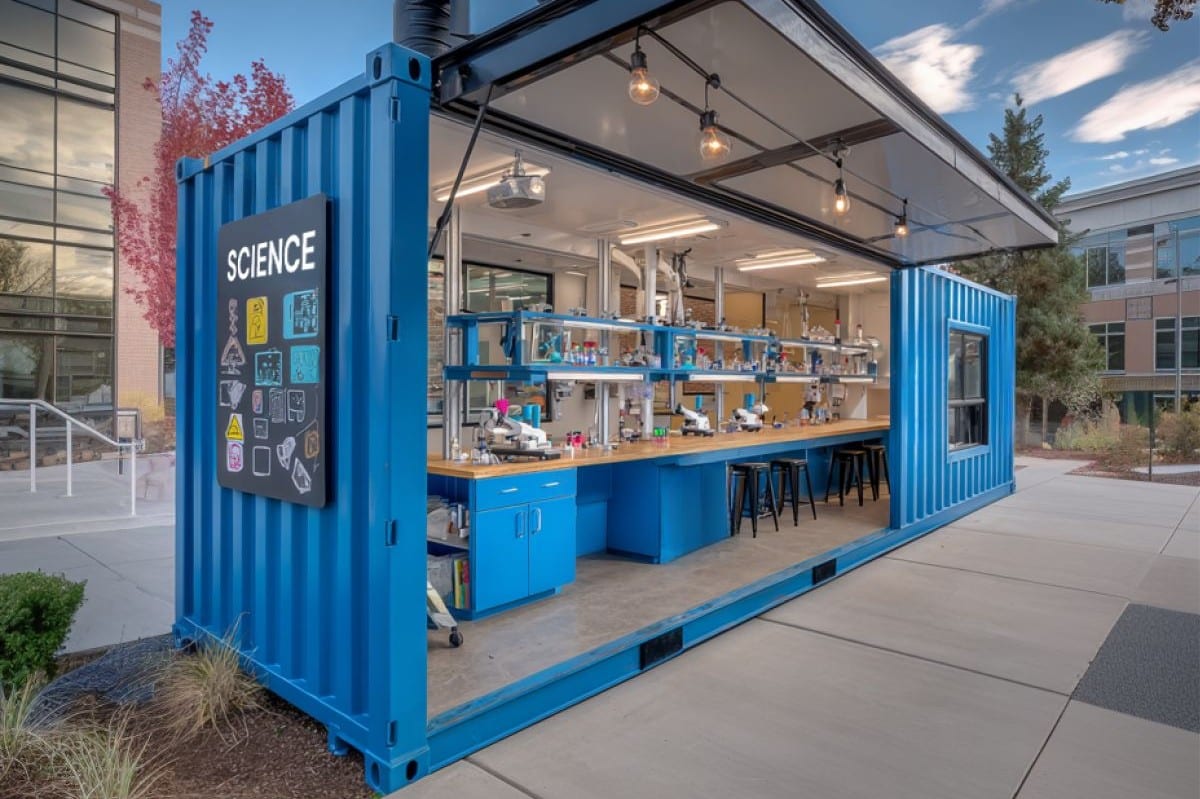
Repurposed shipping containers have already made their mark in housing, retail, and disaster relief. Their appeal? They’re mobile, quick to build, and surprisingly durable.
And now, they’re showing up in a new setting on school grounds.
Container classrooms first appeared in places where traditional construction wasn’t an option: regions hit by natural disasters, rural communities with no infrastructure, or inner-city schools stretched thin on resources.
What started as a last resort is now becoming a smart choice. Their portability, fast setup, and durability are catching the attention of schools looking for flexible solutions that don’t require months of planning or millions in funding.
Beyond mobility, these steel structures offer real advantages when it comes to safety and efficiency. Originally built to withstand extreme climates and long-distance transport, they’re tough by design.
Add insulation, ventilation, and electrical wiring, and you’ve got a space that’s just as functional as any traditional classroom…only faster and easier to set up.
And while the original purpose was practical, today’s container classrooms are showing up in places that simply want something better.
So, what does this actually look like in practice?
Waldorf School, Orange County, California
Waldorf is a private school that became the first school in the United States to turn recycled shipping containers into fully functioning classrooms.
With a budget of $2.1 million, the project added 10,000 square feet of multipurpose space to the campus. The expansion included four classrooms, an art studio, a life science lab, offices, and even a two-story auditorium.
The containers were pre-constructed offsite and assembled on the school grounds in just 99 days. The project also features drought-resistant landscaping and earned Costa Mesa’s Green Design Award.
Girls Athletic Leadership School, Los Angeles (Van Nuys)
In the heart of the San Fernando Valley, an all-girls athletic leadership school was built using 32 recycled shipping containers, which now house 17 classrooms, a dance studio, a rooftop lounge, offices, conference rooms, and a teachers’ lounge.
Spread across two stories and adding 21,000 square feet to the campus, the design gives students—most of whom come from low-income families and identify as students of color—a versatile and creative space to learn and grow.
What makes this project unique is that it was designed by an all-women architectural team. The container-based campus is fire and earthquake resistant and includes sustainable features like LED lighting and rainwater irrigation. The build saved an estimated $2 to $3 million compared to conventional construction.
For Executive Director Vanessa Garza, this wasn’t just about cost or speed, it was about creating a space that reflects the strength and adaptability students are encouraged to carry with them every day.
So, what is it about shipping containers that has been driving schools to lean towards this solution?
Well, first of all, it’s the speed. Traditional construction can take months, even years, to complete especially when budgets are tight or permits drag on. Shipping containers, on the other hand, can be pre-fabricated off-site and installed in a matter of weeks. That kind of turnaround is hard to beat when you’ve got students to serve and no time to waste.
Second of all, it’s the cost. Container construction is significantly cheaper than traditional brick-and-mortar buildings, often saving schools hundreds of thousands if not millions of dollars. For schools working with limited funding or looking to expand without going into debt, containers offer a practical and scalable alternative.
Third, there’s the flexibility. Containers can be stacked, rearranged, expanded, or relocated as needed. Whether it’s adding one extra classroom or building an entire wing, the modular design makes it easy to adapt the space to a school’s changing needs without starting from scratch.
Think about how many things can have been built on school grounds using shipping containers:
- Classrooms built with full electrical wiring, HVAC systems, and Wi-Fi integration
- Science labs outfitted with plumbing, gas lines, and ventilation for lab safety
- Art studios equipped with wash stations, durable flooring, and natural light access
- Dance studios with reinforced flooring, soundproofing, and climate control
- Rooftop lounges supported by steel reinforcement, drainage systems, and safety railings
- Auditoriums featuring acoustic treatments, lighting grids, and AV infrastructure
- Offices wired for Internet, phone lines, and secure access systems
- Conference rooms fitted with power outlets, screens, and presentation tech
- Teacher lounges with breakroom plumbing, appliances, and climate control
- Student dorms equipped with not only beds but bathrooms with fully functional plumbing, private electrical meters, insulation, and shared HVAC
These containers do more than just hold a classroom full of students; they stand up to unpredictable weather, meet safety codes, and still leave room for personality.
With a splash of paint and thoughtful design, they can feel less like industrial boxes and more like inviting, energetic spaces that students actually want to walk into.
This article is courtesy of Conexwest, whose mission is to recycle and repurpose shipping containers into practical, imaginative, and sustainable solutions, www.conexwest.com.