

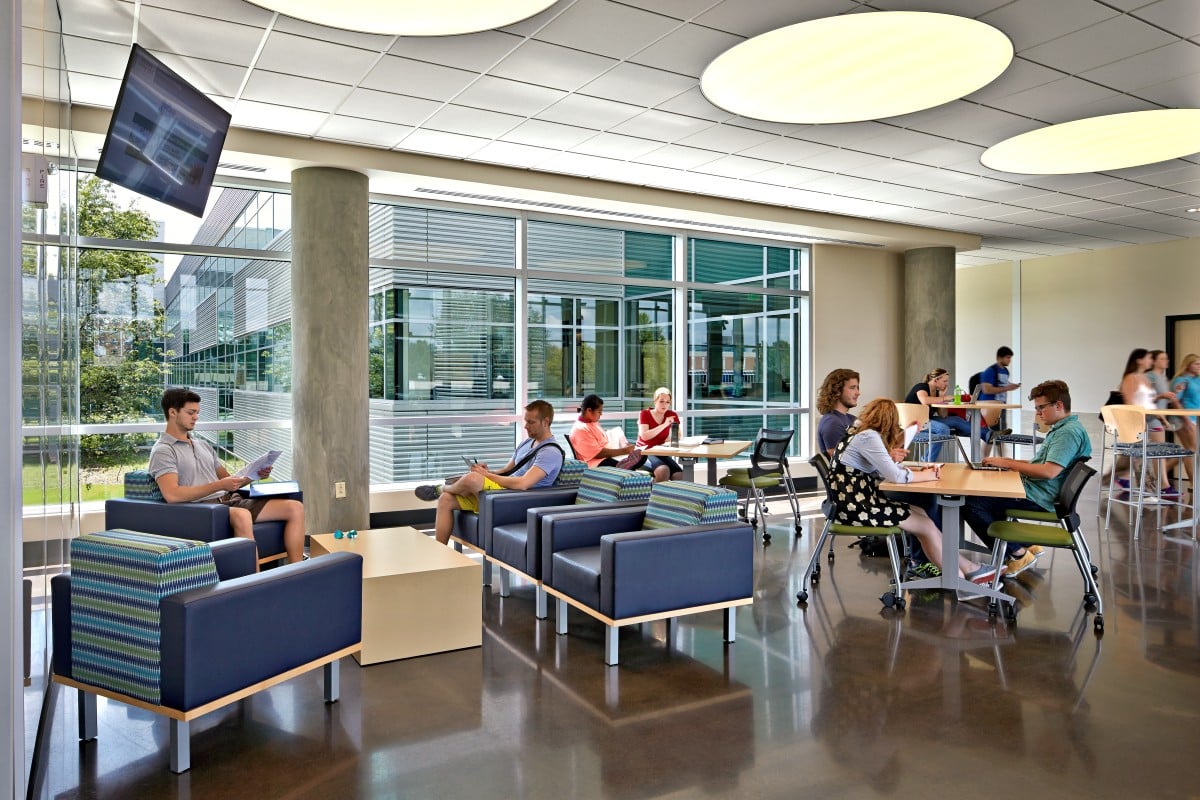
When designing schools of the past, gathering spaces were often siloed for specific purposes. Classrooms were for learning. Cafeterias were for eating. Auditoriums were for assemblies. And outside was for recess.
But as education has shifted and adapted to changes in technology, community, and curriculum, so too have gathering spaces. These spaces have become important environments for creating a vibrant culture and advancing student development.
Now, every space is a learning space, and schools need to have flexible, collaborative hubs where students, teachers, and parents can connect for all types of interactions.
Flexibility as a Foundational Principle
Flexibility within gathering spaces needs to be a key element in today’s school design. Hallways are no longer just passthroughs — they’re places of relationship and an extension of the learning environment.
In a recent education and training facility project designed by TMP, hallways included intentional alcoves outside of classrooms that offered natural stopping points for students to talk to teachers or review notes before class. Informal furniture made the space more inviting for a quick chat or intentional place to study. By incorporating purposeful spots into the circulation design, collaboration is encouraged and square footage is used more efficiently without dedicating space to a single use.
It’s also important to avoid designing overly specialized spaces to keep gathering areas malleable. Many schools find the smaller, specified rooms end up being underutilized. That space could have been used for something more meaningful. That doesn’t mean intimate spaces aren’t needed for certain situations, but for designers to be mindful of a room’s purpose and dodge pigeonholes.
Other elements of flexibility include mobile furniture that can be moved in various configurations, dividing walls in classrooms and auditoriums to create several small spaces out of one large space, acoustic treatments for noise control, and a variety of room styles like flat-floored, tiered, active-learning, and more. These elements allow the space to be arranged for several different needs, and large spaces that would normally have a single programmatic use can be broken down into smaller spaces, further increasing efficiency.
A great example of this is the cafeteria. Once a large space meant only for mealtimes, cafeterias are now being used for all kinds of gatherings. At an elementary school project in Nashville, Tennessee, TMP designed the cafeteria with movable furniture, a performance stage on one end, and interior elements that highlighted the diverse identity of the school. They needed a space that could accommodate the entire population for important announcements and assemblies. So, instead of taking up square footage to design two separate rooms, we met the various needs of the school in one space. The cafeteria was transformed into a multi-purpose space where students eat, but also learn, attend assemblies, and interact with the community.
Design for Connection and Community
Despite the increased use of technology inside — and outside — of schools, research has shown that face-to-face communication is still the core of school interaction. Gathering spaces throughout the facility must support that. More than ever, people are interacting outside of the classroom, so whether student-to-student, student-to-educator, or educator-to-educator, a variety of gathering spaces allow these conversations to happen naturally.
At an educational facility project, TMP included a centralized hallway, or spine, throughout the building with gathering spaces branching off and an anchored station at the end of the hallway. This offered a visible and clear central area so users didn’t have to question whether they were in the right spot. It provided a main space for gathering, before students and teachers broke off into specified areas.
Gathering spaces should also reflect the identity of the school to engage the community and give a sense of ownership. Through interior choices of color, texture, signage, and materials, the mission of the school should be prominent and promoted in a space that’s intended for everyone.
Tech-Enabled and Future-Proof
Technology is now a non-negotiable in the classroom, so it’s imperative that gathering spaces are equipped with power and connectivity sources throughout. Long gone are the days of a separate “computer lab” or moving projectors from room to room.
Today, students and educators are using computers, laptops, tablets, and other tech devices throughout the school. Common spaces, hallways, and classrooms should integrate modern displays in a variety of sizes and camera systems for hybrid or remote participation, as well as infrastructure that empowers digital skill development. Research shows that students have more agency over their learning styles, and environments should bolster that.
With the speed that technology changes, planning for it on the front end keeps facilities functional for the long haul. Additional elements like marker boards, tackboards, outlets, and strong Wi-Fi in gathering spaces also encourage spontaneous collaboration.
All Ages, All Activities
As with all design, gathering spaces are no different when it comes to considering your user. What is the age range of students? What types of activities will they be doing in the space? Younger children may require different materials or furniture than high school students, depending on developmental levels. The space needs to accommodate all.
Be cautious that you’re not simply designing to the trends of the time. Separate them from true future-proofing. The best gathering spaces start as blank canvases that can be shaped by the users.
Look to the Outdoors
Finally, don’t overlook the outdoors as key gathering spaces. Enclosed courtyards, outdoor dining options, and alcoves along a school’s perimeter offer great spaces to gather. At a large high school in Nashville, Tennessee, TMP created three outdoor courtyards by relocating the existing cafeteria and library during renovation. Not only did this create cohesion between the school’s buildings, but it gave more safe green space to socialize, creating more of a campus feel.
The outlook of education facilities will continue to change, but keeping these principles in mind when designing gathering spaces in schools will lead to adaptable, long-term facilities that foster learning, connection, community, and growth.
This article is courtesy of TMP, an architecture and interior design firm that serves people through site, structure, and space, www.tmpartners.com.